Overview
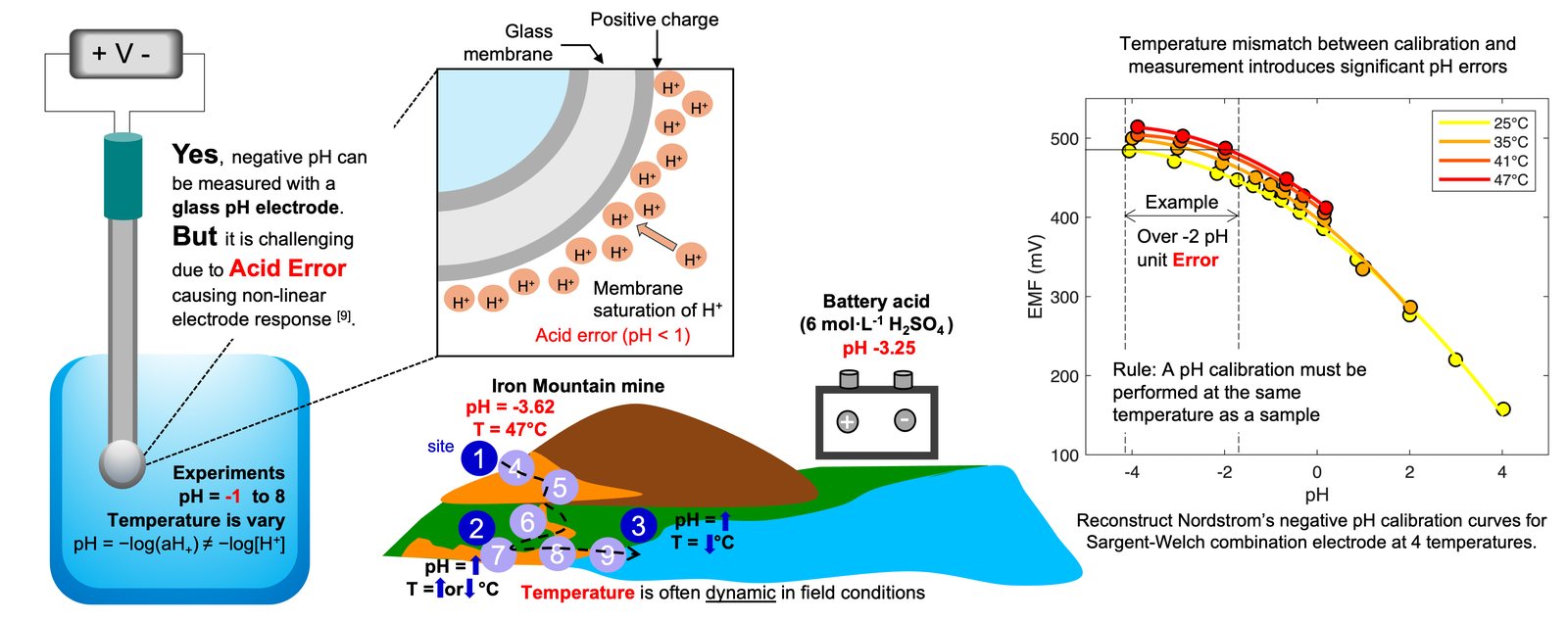
Sulphur dioxide from fossil-fuel combustion and other sources ends up as sulphuric acid in aerosol particles, and thermodynamic models predict particle pH as low as −1 in polluted air. On land, acid mine drainage can be more acidic still: Nordstrom et al. (2000) measured pH −3.6 in waters draining the Iron Mountain mine in California, and some acidic hot springs sit near pH −2.
A glass pH electrode responds linearly only between about pH 1 and pH 11. In the very low and negative range the acid error takes over: the glass membrane becomes saturated with hydrogen ions and the electrode reads too high, by an amount that depends on both acid concentration and temperature. Negative pH can be measured with a glass electrode, but only with a nonlinear calibration, and until recently there was no way to correct that calibration for temperature, which is often dynamic in the field.
Concentrated solutions are also strongly nonideal: ion activities depart far from concentrations, so chemical speciation and reaction rates cannot be predicted from concentrations alone. Aerosol droplets are an extreme case, with very high ionic strength and little water, which is why thermodynamic models are needed to estimate their pH and liquid water content.
My work in this theme develops calibration methods, statistical treatments and software that extend trustworthy pH measurement to the negative-pH range, and applies them, together with activity-based models of nonideal solutions, to kinetic experiments and to atmospheric aerosol that would otherwise be out of reach.
Projects in this theme
Measuring pH where the scale breaks down
Glass pH electrodes become nonlinear in concentrated acids and alkalis. I developed a calibration that extends reliable measurement to negative pH, and software so that other laboratories can use it.
Read more →Fe(II) oxidation kinetics across pH and temperature
A rate law for the oxidation of ferrous iron by oxygen that works from strongly acidic, sulphate-rich solutions to near-neutral water, and across the temperatures found in the atmosphere.
Read more →Aerosol acidity and liquid water during biomass-burning haze
How acidic are the particles in Northern Thailand's dry-season haze, how much water do they hold, and do our thermodynamic models get the answer right?
Read more →Reference
- Nordstrom, D. K., Alpers, C. N., Ptacek, C. J., & Blowes, D. W. (2000). Negative pH and extremely acidic mine waters from Iron Mountain, California. Environmental Science & Technology, 34(2), 254–258.