Background
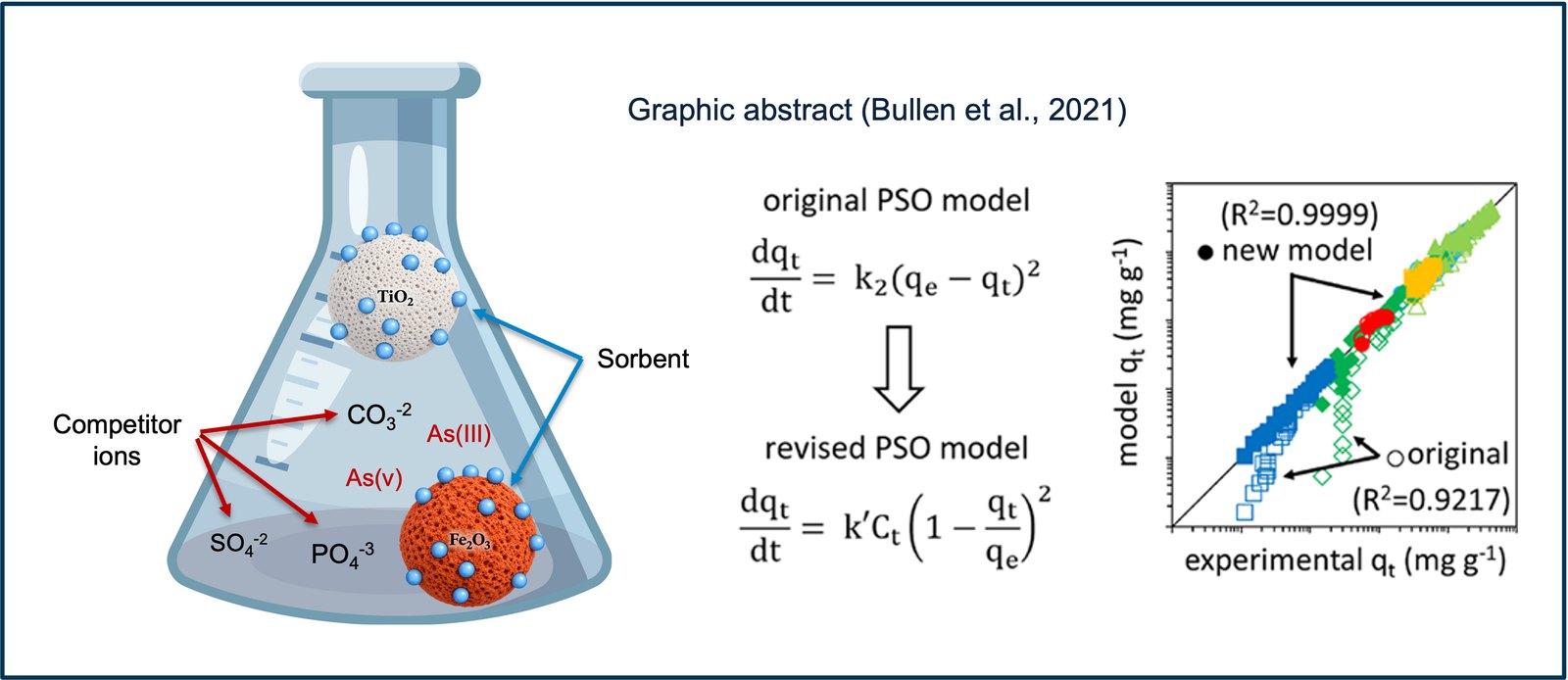
Adsorption onto iron and titanium oxides is one of the main ways arsenic is removed from contaminated water, both in natural systems and in treatment. The kinetics of that uptake are almost universally fitted with the pseudo-second-order (PSO) model. The classic form of the model, however, assumes that one of the two reacting quantities, the dissolved adsorbate or the available surface sites, stays effectively constant during the experiment. In many real experiments neither does, and the fitted rate constants then depend on the experimental conditions rather than on the chemistry.
What I did
As an undergraduate research assistant in the Environmental Geochemistry Group I contributed to a study, led by Jay Bullen, that revised the PSO model so that it explicitly accounts for changes in both adsorbate and adsorbent concentrations. To test the revised model I carried out a systematic extraction and meta-analysis of 36 rate constants from 14 independent studies of arsenic adsorption onto Fe2O3 and TiO2, which allowed the variability in reported kinetics to be evaluated quantitatively across systems. The compiled dataset is openly available on Zenodo.
Why it matters
The revised model gives rate constants that are more comparable between studies, which is what is needed to use laboratory kinetics in reactive-transport models of arsenic in groundwater and in the design of treatment systems. The project was also the start of my interest in getting rate laws right, which later became the centre of my PhD.
Key results
Methods and tools
kinetic modelling · literature meta-analysis · Python
Related publications
- Bullen, J. C., Saleesongsom, S., Gallagher, K., & Weiss, D. J. (2021). A revised pseudo-second-order kinetic model for adsorption, sensitive to changes in adsorbate and adsorbent concentrations. Langmuir, 37(10), 3189–3201.
- Meta-analysis dataset of arsenic adsorption rate constants onto Fe2O3 and TiO2. Zenodo.
Collaborators
Jay Bullen (Imperial, Anglian Water), Kevin Gallagher (University of Rennes), Dominik Weiss (Imperial).